 Get PawLine
Keep your animal's story in PawLine.
Profiles, dated notes and questions in the app. General information, not veterinary diagnosis, treatment or emergency care.


Free to download; see the store listing for current offers, pricing and trial terms.
02 / HOUSEHOLD FIELDBOOK
A system for the handoff, not a substitute for care.
Six chapters to keep identity, source words, observations and responsibility separate. The method is editorial organization, not a validated clinical protocol.
01 / Identity comes before the task
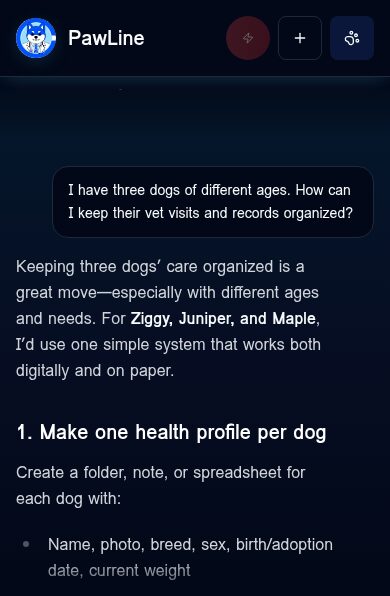
A name on a list is not enough when two animals look alike, share a nickname or answer to the same call. Start with a separate card for each animal. Describe visible distinguishing details in your own words and keep a current photograph with the original record by your agreed private route. AAHA specifically asks multi-pet households to identify who is who in the photographs supplied to a sitter.
Use a stable household label in every related note. If Mica is the cat and Micah is the dog, keep the species attached rather than shortening both to “M”. Do not use an inferred species, age, weight or medical history to fill an incomplete field. Unknown is a useful result because it tells the next person where a question remains.
The desk's local IDs only link its own records. They are not microchip numbers, clinic patient numbers or a verified animal identity. No amount of neat formatting proves that the right animal is in front of the caregiver.
02 / Keep the original instruction in reach
Copying directions into a household note can lose the pet's name, strength, route, timing or storage condition. FDA identifies miscommunication, look-alike names and confusing labels among medication-error causes. Its consumer advice is to read labels, follow directions and keep drugs in original labelled containers.
A reference should say where the original can be found, who supplied it and its date or version if known. Keep the copied words separate from a family paraphrase. If the current label and another note disagree, preserve both accounts and ask the veterinary team to clarify; a newer-looking file name alone does not settle the medical question.
Ask the clinic what to do about a missed dose, a vomited or spat-out dose, accidental excess, storage and unwanted effects. The desk cannot answer those questions. It does not interpret abbreviations, calculate doses or confirm that a medicine is suitable for any species.
03 / A plan and an event are different records
“Due this evening” is a plan. “I saw Rowan receive it at 18:10” is an observation attributed to its observer. “Alex said it was done” is a report. “No one knows” stays unknown. A checked box, an empty packet or an absent food portion does not by itself establish which pet received anything.
The National Capital Poison Center recommends a schedule or checklist when several people give a pet medicine. That is support for coordination, not proof that any particular checklist prevents an error. Our desk deliberately provides no countdown, next-dose calculation or automatic “completed” state.
Write a named source and the actual time if known. When the administration account is uncertain, ask the veterinary team rather than repeating a dose to make the record complete. If an error or exposure may have occurred, contact help immediately, without first finishing the notes.
04 / The supply location is not a safety assessment
A sitter must find the right supplies, but a convenient shelf is not necessarily a secure storage location. FDA notes that pets can climb, knock containers down or chew through packaging, including containers described as child safe. Keep medicines secure, in original containers with intact labels, and store each person's and pet's medicines separately.
List the correct food, bowl, carrier or lead location for each animal without inventing a feeding amount or separation plan. AAHA's sitter guidance asks about meal times, amounts, supervision and separate feeding locations; the answers come from this household's actual instructions and veterinary team.
Do a locating exercise with empty hands. Do not open a drug container or administer anything just to demonstrate that you can find it. A fictional walkthrough is not a practice treatment. Keep home access codes, passwords and payment details out of general worksheets and exports.
05 / Contacts need an agreed role
ASPCA asks owners to leave contact information, a backup person, veterinary and emergency-clinic details, and a plan for what the sitter should do. It also says to tell the veterinarian who is authorized to make decisions while the owner is unavailable. A worksheet naming someone does not itself grant that authority.
For each species, verify the clinic's accepted patients, contact route and availability directly. Writing a clinic's name does not prove it can receive that pet, is open, has capacity or has agreed to the plan. Record what was checked and when, with remaining limits in plain language.
Share only the information the receiving person needs, through an agreed route. Downloading, printing or copying a packet does not send it. Sending does not prove that it was received, read or accepted. Keep the human confirmation separate from the export action.
06 / Replace a version without rewriting history
When a professional direction changes, keep its original words and source date available. Mark the older household copy as superseded only when you have actually confirmed the replacement. Do not quietly overwrite a record that another caregiver may still be using.
Agree where the working copy lives and how the receiving person will recognize its version. An offline printout can help if a device fails, but it may be stale. Put a version or preparation date on the packet and use the walkthrough to ask which copies still need replacing.
The browser desk is intentionally a temporary workspace, not a shared task system, cloud backup, reminder service or clinical audit trail. Reloading clears its working state. Keep a JSON export privately if you need to reopen it; check it against current originals before reuse. Reopening yesterday's file never proves that yesterday's instructions are still current.
Put the method to work
Open the desk · Rehearse a readback · Use the blank paper kit
- FDA: veterinary medication errors
- FDA: medication storage
- ASPCA: pet sitter safety
- AAHA: essential sitter instructions
- National Capital Poison Center: pets and medication errors
Sources read November 11, 2026. This is a source-check date, not a clinical review or the sources' publication date. No source endorses this tool.
Get PawLineKeep your animal's story in PawLine.
Profiles, dated notes and questions in the app. General information, not veterinary diagnosis, treatment or emergency care.
Free to download; see the store listing for current offers, pricing and trial terms.